प्रतीक्षा करें
Summoning entity profiles from the Grimoire…
प्रतीक्षा करें
Summoning entity profiles from the Grimoire…


Vidyadhara
They move through the upper air between the Himalayas and the Vindhyas, and the old texts — the Kathāsaritsāgara most precisely — describe them as neither god nor demon but something pleasurably in between. A Vidyadhara carries a vidyā, a living spell absorbed through years of forest austerity or stolen from a distracted siddha, and this knowledge is not metaphor. It is a technology. Accounts from the Shaiva pilgrimage routes near Ujjain and the Amarakantak headwaters describe ascetics encountering figures of extraordinary beauty at high altitude, figures who spoke in flawless Sanskrit, offered company, and were gone by the time the fog lifted from the Narmada's upper course.
The danger they present is not violence but displacement — from purpose, from vow, from the life you intended to return to. Sanskrit narrative literature treats them as catalysts for digression: a hero pauses, meets a Vidyadhara woman or man on a mountain ledge above the clouds, and the story folds into years. The Brihatkatha tradition is dense with such encounters, and the tone is never quite warning and never quite endorsement. What the oral accounts from the hill communities of the Maikal range add — and what the texts omit — is the specific quality of the longing that persists afterward, a hunger for altitude that the affected person cannot explain and cannot satisfy at ground level. They spend the rest of their lives looking up.
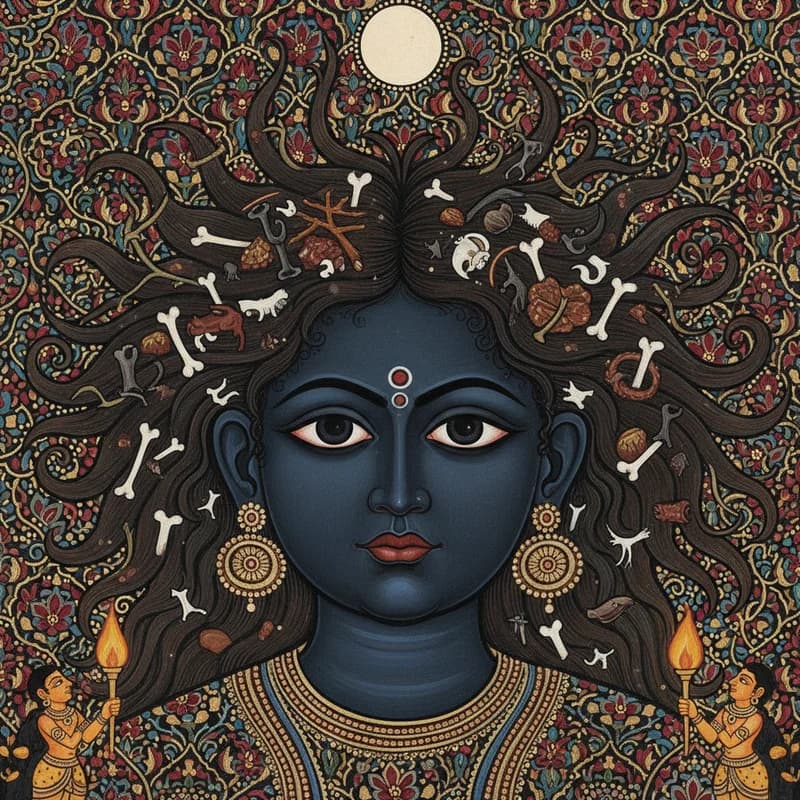
The Vidyadhara appears as a figure of unsettling beauty — neither young nor old, the face too symmetrical, the proportions too exact, as though assembled by someone who had studied human form from a great distance and made no errors. The skin carries a faint luminescence that is not light but the absence of shadow; no fold of clothing, no hollow beneath the jaw, falls dark the way it should. Accounts from the Himalayan foothills near Kedarnath describe a sound that precedes them — not music exactly, but the sensation of music, a pressure behind the ears like a note held just beyond hearing. Their feet do not quite meet the ground. The single consistent detail across oral records from Kumaon to the Vindhya forests is this: when they pass, the air smells briefly of rain on heated stone — petrichor, but arriving from no cloud.
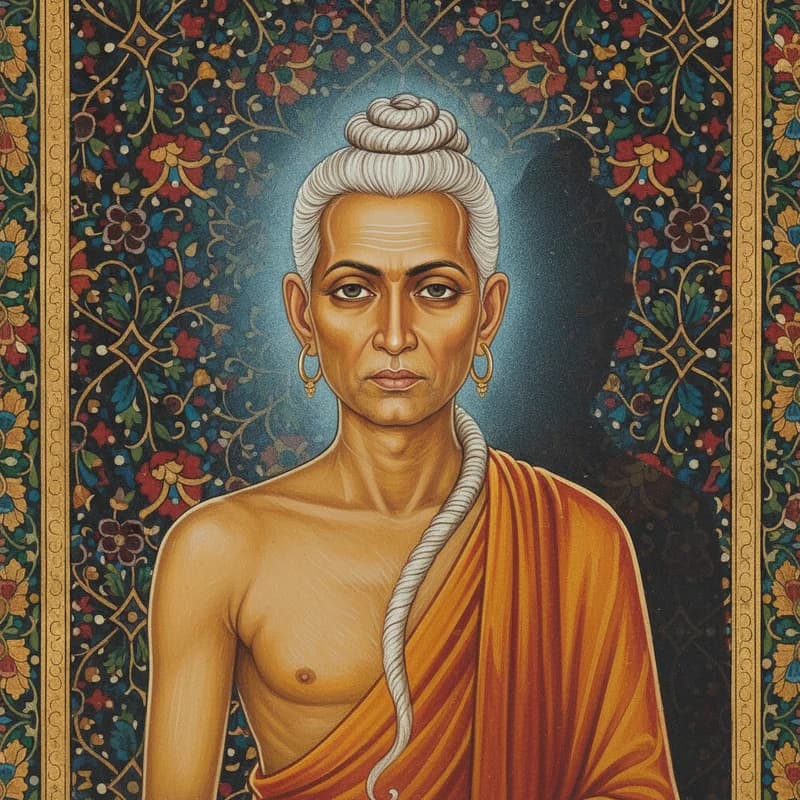
Along the Narmada's northern bank, where the sal forests thin toward the Vindhya escarpment and wandering scholars are unremarkable in any season, Vidyadharas have been documented taking the form of an itinerant pandit — dusty dhoti, a cloth bag of manuscripts, the unhurried bearing of a man who has walked many roads and expects to walk many more. The disguise is nearly perfect. Two details betray it, noted independently across accounts collected from Hoshangabad to Amarkantak: the manuscripts, when glimpsed, contain no writing that holds still — the characters shift or rearrange between one glance and the next, as though the text is still deciding what it means. The second tell is simpler and colder — in open ground, with no tree overhead, the man casts no shadow at noon.
First Documented
The Vidyadharas appear among the earliest stratified lists of supernatural beings in the Atharvaveda, where sky-dwelling spirits with occult knowledge are catalogued alongside gandharvas and apsaras. Their most sustained literary presence emerges in the Kathāsaritsāgara of Somadeva, the eleventh-century Kashmiri poet, where they populate entire narrative cycles as enchanted lovers and keepers of aerial cities.
Last Recorded
Accounts of Vidyadharas surface as recently as the 1980s in oral traditions collected from the Kumaon hills, where singers of *Jagars* still invoke their presence during night ceremonies. The sightings have thinned, but the knowledge-holders have not entirely gone quiet.
Source Language
Sanskrit
Origin
The Vidyadhara enters Sanskrit literature as a coherent class of beings in the Mahabharata and the Ramayana, where they appear in the sky above battlefield scenes and mountain summits — neither fully divine nor mortal, but occupying the intermediate air between Meru and the earth. The Vishnu Purana and the Harivamsa elaborate them into a ranked supernatural order, possessing vidya, the secret syllabic formulae that grant flight and transformation. What the texts insist upon is their acquisition of power through knowledge — they earned their aerial station. The oral traditions of the Kumaon hills and the forested ridges above the Narmada's upper reaches tell it differently: the Vidyadharas did not earn their knowledge but stole it, lifting mantras from sages absorbed in meditation at high altitudes, carrying the syllables skyward before the sage could wake and reclaim them. This divergence is not incidental. The textual account makes them aspirants; the folk account makes them thieves — and that distinction quietly changes what it means when village healers in Balaghat district still invoke a Vidyadh
Frequently Asked
Vidyadharas are a class of semi-divine aerial beings who dwell in the sky and mountain peaks, possessing secret magical knowledge — their name literally means 'holders of vidya,' or bearers of occult learning. They appear across Sanskrit epics, Puranas, and Jain cosmological texts as beautiful, carefree spirits capable of flight, shapeshifting, and wielding powerful mantras. Unlike strictly malevolent spirits, Vidyadharas occupy a middle tier of the celestial hierarchy, closer to humans than gods but far beyond ordinary mortals in power.
The Vishnu Purana and the Mahabharata place Vidyadharas in the high Himalayan peaks and the atmospheric spaces between earth and the heavens — the antarikshaloka. Specific mountain ranges like the Gandhamadana and the Himavat are named as their preferred haunts, where they gather in pleasure groves invisible to human eyes. Travelers crossing high passes in Uttarakhand and Himachal Pradesh have long reported strange lights and music attributed to Vidyadhara gatherings.
Vidyadharas can fly without mechanical aid, assume any form at will, and command powerful vidyas — secret syllabic formulas that can alter reality, grant invisibility, or compel other beings. Their mastery of these mantras is the source of both their name and their authority among supernatural beings. In the Kathasaritsagara, Vidyadharas frequently use these powers to intervene in human love affairs, wars, and quests, sometimes as helpers and sometimes as obstacles.
Vidyadharas are neither uniformly benevolent nor malicious — they are driven by desire, pride, and curiosity in ways that make them unpredictable. The Kathasaritsagara, compiled in Kashmir during the 11th century, portrays them as passionate beings who fall in love with humans, engage in rivalries, and sometimes curse or bless mortals on a whim. Approaching them with caution is wise; their goodwill is real but conditional, and their displeasure can be swift.
Both Vidyadharas and Gandharvas are aerial semi-divine beings associated with beauty and music, but Gandharvas are primarily celestial musicians tied to the court of Indra and the ritual order of the cosmos. Vidyadharas are defined specifically by their possession of occult knowledge and magical formulas, making them more akin to aerial sorcerers than divine performers. The Ramayana distinguishes them clearly — Gandharvas sing at divine assemblies while Vidyadharas appear as independent agents pursuing their own desires across the sky.
Sanskrit kavya tradition consistently portrays Vidyadharas as strikingly beautiful, adorned with garlands, and accompanied by their equally radiant consorts — the Vidyadharis. Kalidasa invokes them in the Meghaduta as witnesses to the Yaksha's longing, placing them in the cloud-wrapped peaks above the Narmada valley. Their romantic entanglements with human heroes form the backbone of many tales in the Brihatkatha tradition, where a mortal man winning a Vidyadhara woman's love is a recurring narrative arc.
Yes — Vidyadharas feature prominently in Jain cosmology, where they inhabit specific tiers of the Madhyaloka, the middle world, and are considered beings of great but impermanent power. Buddhist texts from the Pali canon and later Mahayana literature also reference Vidyadharas as sky-dwelling beings who guard esoteric knowledge, particularly in tantric traditions where the term vidyadhara came to mean a master of secret mantra practice. Across all three traditions, the core identity holds: these are beings defined by what they know and what that knowledge allows them to do.
Several Sanskrit narratives describe humans ascending to Vidyadhara status through the successful mastery of a vidya — a process that requires years of isolated practice, often in forests like the Vindhya or along the banks of the Godavari during the monsoon months when such powers are said to be most accessible. The Kathasaritsagara records multiple such transformations, treating them as extraordinary but not impossible achievements. The implication is consistent: Vidyadhara is as much a condition of knowledge as it is a species of being.
संबंधित लोकगाथाएं
Related Lore
Algorithmic Inference
आपको यह भी पसंद आ सकता है
You May Also Like
Community Discussion
Comments are reviewed by AI before appearing publicly. Unsafe, unrelated, or uncertain comments go to human review.
Sign in to join the discussion.
0 comments
No public comments yet.